Should You Show a Delivery Date on Your Product Page? (2026)
The delivery date is the most honest line on your product page. It is a promise your operations team has to keep in public, which is why so many brands quietly leave it blank. That blank is not neutrality. It reads to a shopper as "we are not sure when this will reach you," and uncertainty at the moment of decision is where orders go to die.
So the real question is not whether a delivery date helps. It does. The question is whether your fulfilment has earned you the right to show one.
The blank space where a delivery date should sit is quietly costing you orders
A missing or vague delivery estimate removes the one piece of information a ready-to-buy customer is actually looking for. Roughly seven in ten online carts are abandoned before purchase (Baymard Institute meta-analysis of around 50 studies, updated September 2025), and delivery friction sits near the top of the fixable reasons: about 39% of shoppers walk away over unclear or high shipping costs and around 21% because delivery was judged too slow (Baymard, 2025). These are US and global figures, so treat them as directional for the Indian market, but the direction is not in question.
Baymard’s own recommendation is blunt: show an estimated delivery date, not just a shipping speed, and show it early. "Ships in 5 to 7 days" asks the customer to do the mental maths. "Arrives by Thursday, 14 August" removes the doubt. In metro India the reference point is harsher still. A generation of shoppers now anchors to same-day and next-day delivery as the normal case, so a silent product page or a week-long window reads as a brand that has not solved its logistics. If you want the numbers behind whether your operation can even make a credible promise, our breakdown of the fulfilment metrics that actually predict delivery performance is the place to start.
A delivery date you cannot hit does more damage than showing none
Here is the uncomfortable part. The fix is not to slap an aggressive date on the page and hope. Research from Shopify suggests that over-promising generates more post-purchase pain than slow shipping ever does, because a missed date turns a satisfied buyer into an anxious one.
The cost shows up immediately as WISMO, the "where is my order" queries that already swallow a large share of support. Industry estimates put WISMO at 30% to 60% of ecommerce support tickets, and India-specific estimates run above 50% (directional, per logistics-industry reporting). A useful operator benchmark: under 3% of shipped orders generating a WISMO contact is healthy, 3% to 8% is common but reducible, and anything above 8% points at a structural problem in your promises or your carrier lanes, not your support scripts.
A broken promise does not stop at a support ticket. It becomes a refund request, a cancellation, sometimes a return to origin (RTO reduction is far easier when the customer is not already annoyed by a late parcel), and a dent in the repeat rate and NPS you spent real money to build. The rule is simple: accuracy beats speed. A date you hit nine times out of ten is worth more than a faster date you hit six times out of ten.
What delivery promise can you actually make? Match the date to the fulfilment model
The precision of the date you can safely show is set by one thing: how close your stock sits to the customer. You cannot buy a better delivery date with better copywriting. You buy it with better inventory placement. The table below maps the promise to the setup that backs it.
| Fulfilment setup | Promise you can credibly show | Precision | Where it breaks |
| Single central warehouse, surface courier | "Delivered in 5 to 7 days" (a range, not a date) | Low | Long wait drives abandonment and higher RTO |
| Regional or zonal warehouses | "Delivered by [date], 2 to 3 days" | Medium | Still misses the metro same-day expectation |
| Dark store or hyperlocal network | "Same-day or next-day, arrives by [date]" at pincode level | High | Requires disciplined stock placement per node |
| Quick commerce, 30 to 60 minutes | "Delivered in 30 to 60 minutes" | Highest | Only for stocked SKUs in serviced pincodes |
The pattern is the point. Every step up in promise precision is a step up in how close your inventory lives to demand. A dark store network and controlled last-mile delivery are what let you show a same-day date on a product page and actually keep it. A single far-away warehouse limits you to a vague range, no matter how sharp your product-page design is.
In 2026, your delivery date is not only read by humans
The delivery promise has quietly become machine-readable, and that changes the stakes. Google reads the estimated delivery date from your product structured data, specifically the Offer, shippingDetails and deliveryTime fields (handling time plus transit time), and has been surfacing "Get it by [date]" annotations on Shopping and organic product results since April 2023. Through 2026, shippingDetails has shifted from a "recommended" field to one that is effectively required to compete for that space (directional, per practitioner reporting, though consistent with Google’s own documentation).
There is a second, newer reason to get this right. AI shopping assistants and answer engines increasingly read these same fields to compare options on a shopper’s behalf. If your delivery promise exists only as a graphic badge and not in structured data, the machine deciding what to recommend may simply skip you. Two gates have to be cleared: your page has to be retrievable, and your delivery data has to be quotable in a form a model can lift. One more discipline matters here: the visible date on the page and the date in your schema must match exactly, or you look unreliable to both the crawler and the customer. For why owning your product page (rather than living inside a marketplace listing) gives you control over this promise in the first place, see our note on selling on your own channel versus a marketplace.
A credible delivery date is an operations output, not a copy decision
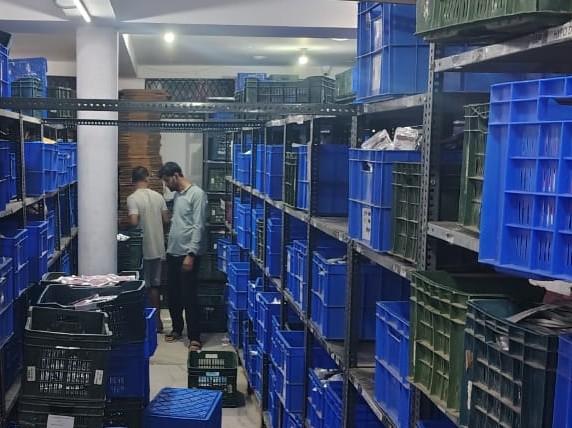
This is where the whole argument resolves. A delivery date holds when three things are true, and all three are infrastructure questions, not marketing ones. First, the capacity behind it is reserved for you, not borrowed from a shared pool that quietly reprioritizes your orders during a festive peak. Second, inventory sits close to demand, in a dark store network spread across the cities where your customers actually are. Third, the last mile runs on your standards, so the parcel that leaves matches the date you printed.
Zippee is built as exactly that layer. We run the dark stores, the hyperlocal fulfilment and the dedicated last-mile delivery that let a D2C brand show an aggressive delivery date and keep it, across a network spanning 21 cities including Delhi NCR, Mumbai, Bengaluru and Hyderabad. Because the sale happens on the brand’s own website, the brand keeps its first-party customer data and stays in control of the promise it makes. That is the difference between an estimated delivery date that is marketing and one that is a number you can stand behind.
The verdict
So, should you show a delivery date on your product page? Yes, but only the date your fulfilment has earned. The badge is easy. The operation that keeps the badge honest is the hard part, and it is the part that compounds into conversion, lower RTO, fewer WISMO tickets and a better NPS. Treat fulfilment as infrastructure and the delivery date stops being a risk you hide and becomes a claim you win on.
If you’re ready to turn your fulfilment into a competitive advantage, join our waitlist.


.png&w=256&q=75)
.png&w=256&q=75)


.png&w=256&q=75)


