Dark Stores vs FSLs - Best Model for D2C in 2026
Most D2C brands that think they need a dark store actually need a Forward Stocking Location. And most brands sitting on FSLs are quietly leaking orders they could have fulfilled in 30 minutes.
The conversation around hyperlocal delivery infrastructure has gotten noisy. Every logistics vendor has an opinion, usually shaped by what they happen to sell. So here is a framework built on what actually drives unit economics for D2C brands at scale, not a vendor pitch.
What's the Actual Difference Between a Dark Store and an FSL?
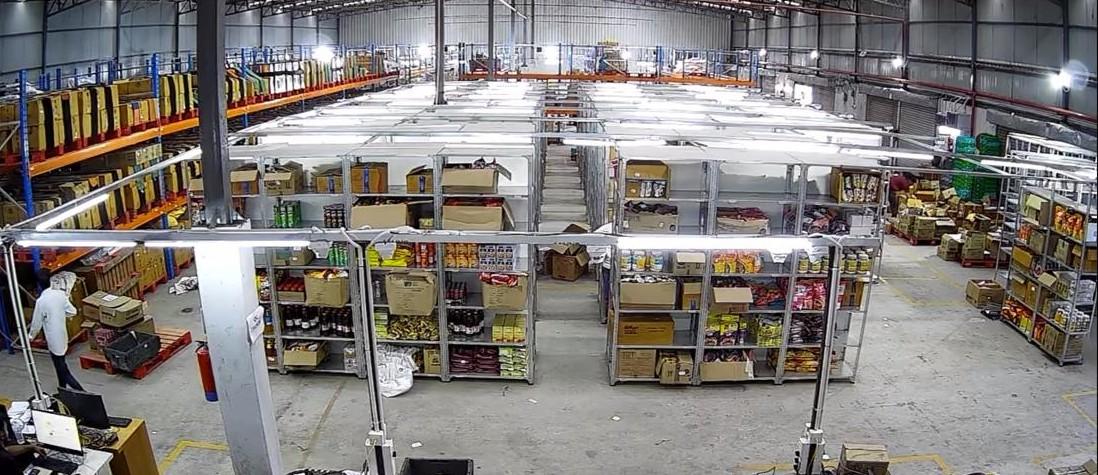
A dark store is a dedicated micro-fulfillment facility, purpose-built for fast picking and packing, carrying 500 to 2,000 SKUs, designed to dispatch orders in under 10 minutes. Think of it as a small distribution center optimized entirely for speed, not retail footfall.
A Forward Stocking Location (FSL) is a leaner inventory buffer, typically 200 to 800 sq ft, positioned close to a delivery zone. It holds a curated subset of your catalogue, usually your top 20 to 80 SKUs by demand density, and is designed to reduce last-mile distance rather than replace your main warehouse.
Dark stores give you range. FSLs give you proximity. The wrong choice between the two is one of the most common reasons fulfillment costs spiral for scaling D2C brands.
When an FSL Is the Right Choice for Your Brand
The Economics: FSL Break-Even vs. Dark Store Break-Even
If your catalogue has a clear demand tail, meaning 20% of your SKUs drive 80% or more of your daily orders, an FSL is almost always the better starting point. You stock the fast-movers close to the customer, keep the long tail in a hub, and achieve same-day delivery for the bulk of your orders without the fixed cost of running a full dark store.
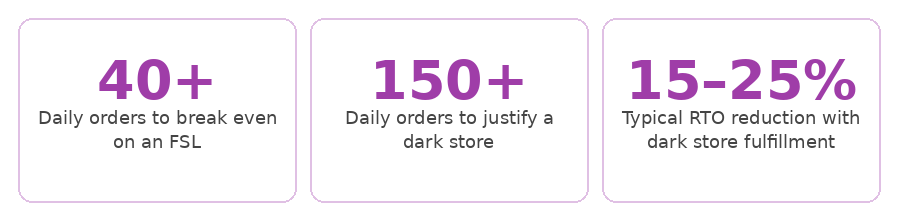
FSLs also work well if you are entering a new city and need to validate demand before committing infrastructure. The break-even on a typical FSL, based on directional benchmarks from Zippee's network, comes in at roughly 40 to 60 daily shipments. A dark store in the same city typically requires 150 or more daily shipments to make financial sense at current real estate and staffing costs in metros like Mumbai or Bengaluru.
How Brands Like Epigamia and Supertails Use FSL-First Expansion
Brands like Epigamia and Supertails use FSL-first strategies in newer cities, adding dark store capacity only when a zone sustains 90+ daily orders consistently over 6 to 8 weeks. This prevents the common trap of over-indexing on infrastructure before demand validates.
When a Dark Store Earns Its Place
Order Density, SKU Breadth, and Hard SLA Commitments
Dark stores earn their place when three conditions are true at once: high order density in a zone, a broad SKU requirement per order, and a hard SLA commitment (30 or 60 minutes).
Health and wellness brands with large basket sizes, brands operating on marketplaces with strict SLA windows, or brands where the consumer experience is built around product variety, these are the profiles where a dark store's picking efficiency justifies the fixed cost premium.
The RTO Reduction Case for Dark Store Fulfillment
RTO reduction is another underappreciated argument for dark stores. When you fulfill from closer to the customer, delivery windows tighten, communication improves, and return-to-origin rates drop. Based on directional data from Zippee's fulfillment network, brands that shift from a hub-and-spoke model to dark store fulfillment for their top urban zones see RTO rates fall by 15 to 25 percentage points. Directional estimate; results vary by category and city.
Dark Store vs. FSL: Side-by-Side Comparison by Key Criteria
All figures are directional benchmarks from Zippee network operations. Individual brand results vary by category, city, and basket size.
| Criteria | Dark Store | FSL | Edge |
| Min. daily orders to break even | 150+ | 40-60 | FSL wins |
| SKU range per zone | 500-2000 | 20-80 | Dark Store |
| Delivery SLA achievable | 10-30 min | 30-90 min | Dark Store |
| Infrastructure cost (monthly) | High | Low-medium | FSL wins |
| RTO reduction potential | High | medium | Dark Store |
| Speed to activate in new city | 6-12 weeks | 2-4 weeks | FSL wins |
| Inventory visibility and control | High | medium | Dark Store |
| Right for catalogue-heavy brands | Yes | Limited | Dark Store |
| Right for focused SKU brands | Overkill | Yes | FSL wins |
| Hybrid model possible | Yes | Yes | Tie |
The Hybrid Architecture Most Scaling Brands Should Be Running
How a Tiered FSL + Hub Model Works in Practice
The real unlock for most scaling D2C brands is not a binary choice. It is a tiered architecture: a regional dark store or hub handling the full catalogue, combined with FSLs in high-density micromarkets stocking only your top-moving SKUs.
This is how brands like HealthKart serve customers in Gurugram, Bandra, or Koramangala with 60-minute delivery on a full catalogue while keeping infrastructure costs disciplined. The FSLs absorb the volume; the dark store or hub handles complexity and replenishment.
For a deeper look at how inventory placement decisions affect fulfillment costs, the post on last-mile cost optimization for D2C brands on the Zippee blog is worth reading alongside this one: Our SKU selection framework for dark store inventory.
How Zippee's Network Supports Both Models Across 21 Cities
Zippee operates a network of dark stores and FSLs across 21 cities, covering Delhi NCR, Mumbai, Bengaluru, Hyderabad, and expanding markets. For D2C brands and marketplaces, Zippee functions as infrastructure, not a courier.
The distinction matters. A courier picks up your shipment and delivers it. Infrastructure means your inventory is already positioned close to the buyer before the order is even placed. That is the difference between a 4-hour SLA and a 30-minute one, and between a 35% RTO rate and a 12% one.
Brands like Clinikally and Myntra use Zippee's network to make same-day delivery a default experience, not a premium add-on. The operational model is designed so brands do not need to choose between speed and unit economics. You get the FSL or dark store coverage that fits your demand profile, and it scales as your orders grow.
The Bottom Line
Dark stores are not a default upgrade. They are the right tool for a specific demand and SLA profile. FSLs are not a compromise; for most brands below 100 to 120 daily orders in a zone, they are the economically correct model.
The brands getting this right in 2026 are not the ones spending the most on infrastructure. They are the ones matching infrastructure decisions to their actual order density, catalogue depth, and delivery promise. Build the stack that fits your current numbers, with a clear trigger to evolve it.
Ready to turn fulfillment into a competitive advantage? Join our waitlist


.png&w=256&q=75)
.png&w=256&q=75)


.png&w=256&q=75)


