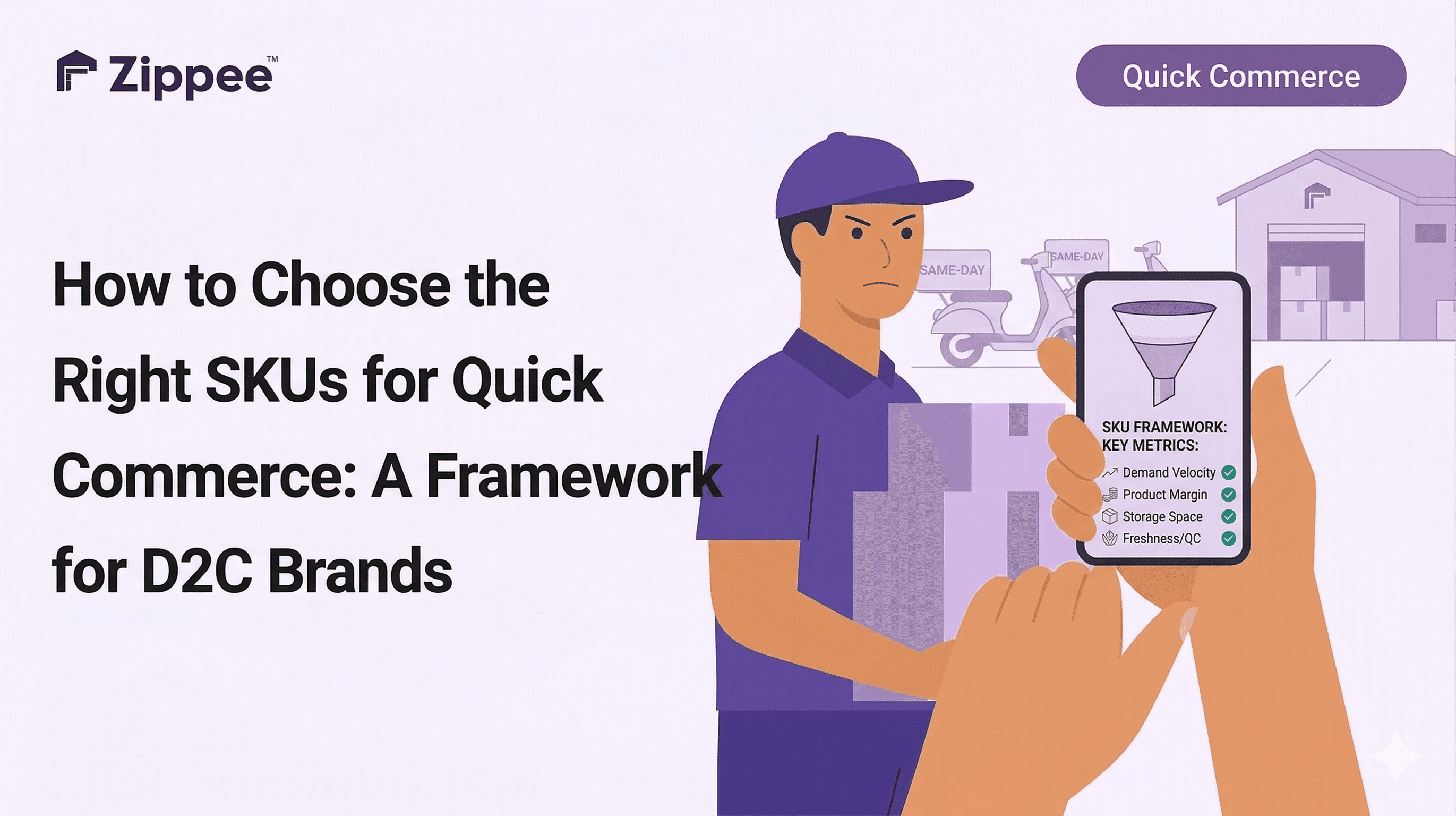
How to Choose the Right SKUs for Quick Commerce: A Framework for D2C Brands
The most common mistake D2C brands make when entering quick commerce: they list everything.
It seems logical. More SKUs means more surface area for customers to find you. But in quick commerce, that logic breaks down fast. Dark store shelf space is finite and expensive. Pick-pack speed matters more than assortment breadth. And a SKU that doesn't sell within 48 hours is dead inventory occupying space that your top-performing product could be sitting in.
The brands that win in q-comm treat SKU selection as a deliberate decision, not a default. Here's the framework they use.
Why Not All SKUs Are Q-Comm SKUs
Dark stores are not warehouses. A warehouse is optimized for storage density and long-term holding. A dark store is optimized for pick speed, high inventory turnover, and spatial efficiency. The economics are completely different.
In a traditional warehouse, holding a slow-moving SKU for 30 days costs you storage cost per cubic foot. In a dark store, that same slow-mover is occupying a slot that could turn over 15 times in 30 days if it had the right product. The opportunity cost is much higher.
Add to that: packaging requirements (dark stores have strict dimension and weight constraints), pick error rates (SKUs that are hard to distinguish from each other cause fulfillment errors), and the fact that q-comm customers have high expectations for product condition — a SKU that's fragile or poorly packaged will generate returns and negative reviews at a disproportionate rate.
The question isn't which SKUs can go into a dark store. It's which SKUs should.
The 5-Criteria SKU Filter
Run every SKU through this before sending it to a dark store node:
| Criterion | The test | What failure looks like |
| 1. Velocity | Will this SKU sell at least 5-10 units per day from this dark store? | A SKU moving 1-2 units per day is a storage cost, not a revenue driver. Pull it. |
| 2. Unit economics | After dark store handling fees and last-mile cost, is the margin positive? | Many brands discover their lower-priced SKUs have negative contribution margin in q-comm. Know your numbers before listing. |
| 3. Urgency | Would a customer need this product within 2 hours — not just want it? | A scented candle is a want. A paracetamol is a need. Urgency drives same-day conversion. Wants can wait for next-day. |
| 4. Shelf life and fragility | Can this product survive the pick-pack-dispatch-deliver cycle without degrading? | Fragile products, perishables without cold chain, and anything requiring special handling are high-risk in a fast-moving dark store environment. |
| 5. Packaging compliance | Is the packaging compact, clearly labeled, and scan-ready? | Bulky, irregular, or unlabeled packaging slows down pick speed, increases error rates, and may be rejected by the dark store operator entirely. |
A SKU that fails even one of these criteria is a candidate for exclusion from your dark store assortment. Two failures is a clear no.
Category-by-Category Patterns
After running the framework across categories, here's what consistently holds:
- Health and wellness: Supplements, vitamins, OTC essentials, and personal care consumables score well on urgency and velocity. Top performers are small-format, high-frequency reorders: protein bars, daily supplements, sunscreen. Avoid large-format bundles and anything requiring refrigeration unless you have cold chain.
- Beauty and skincare: Hero SKUs (bestselling moisturizers, serums, lip products) perform. Full-range listings don't. Customers ordering beauty on q-comm know exactly what they want — they're replenishing, not browsing. List your top 5 SKUs by repeat purchase rate, not your full catalog.
- Pet care: Pet food and treats have exceptional urgency scores — 'the dog ran out of food' is one of the highest-intent purchase moments in ecommerce. Portion-pack formats outperform bulk bags in dark stores due to weight and handling constraints.
- FMCG: Consumables with short replenishment cycles work well: cleaning products, personal hygiene, snacks. The SKUs that fail here are the ones with low urgency and low velocity — niche variants, seasonal items, and anything where the customer is equally likely to add it to their next Blinkit order.
- Fashion and apparel: Generally a poor fit for dark stores. No urgency, high return rates, size/variant complexity, and a customer mindset oriented toward browsing, not immediate fulfillment. Exceptions exist (basics, socks, innerwear with low return rates), but this category requires careful analysis before listing.
The Pilot Framework: Test Before You Commit
Before sending inventory to multiple dark store nodes across cities, run a controlled pilot:
- Select 4-6 SKUs maximum: Choose products that pass all 5 criteria and represent your highest-velocity, highest-urgency items. These are your proof-of-concept candidates.
- One city, one dark store node: Start with the geography where your existing customer concentration is highest. This gives you the best chance of hitting velocity thresholds.
- Run for 30 days: Track sell-through rate, RTO rate, pick accuracy, and customer return rate by SKU. These four metrics tell you whether a SKU belongs in q-comm or not.
- Set an exit threshold: Define in advance what failure looks like. If a SKU doesn't hit 5 units per day by day 14, it gets pulled. No exceptions — dead inventory has a real cost.
- Scale what works, cut what doesn't: After 30 days, you should have 2-3 SKUs with strong data. Expand those to additional nodes. The underperformers stay out of the next pilot.
Common Mistakes to Avoid
A few patterns appear repeatedly in brands that struggle with q-comm SKU management:
- Over-assortment: Listing 30 SKUs to 'cover all bases' dilutes inventory across nodes, reduces velocity per SKU, and makes restocking harder to manage. Start narrow.
- Ignoring return rates by SKU: A SKU with a 15% return rate in standard ecommerce will likely have a similar or higher return rate in q-comm. High-return SKUs cost more to operate in dark stores because reverse logistics from hyperlocal is disproportionately expensive.
- Choosing 'hero SKUs' by brand preference, not data: The SKU you're proudest of is not necessarily the one that has q-comm demand. Let velocity data, not intuition, drive the selection.
Conclusion
Quick commerce rewards focus. The brands that treat their dark store assortment with the same discipline as their ad spend — testing, measuring, and ruthlessly cutting what doesn't work — are the ones that build sustainable q-comm operations with healthy margins.
The 5-criteria framework above gives you a starting point. The pilot data gives you the evidence. Together, they let you build a q-comm assortment that actually performs.
Zippee helps D2C brands plan and execute their dark store inventory strategy across Delhi NCR, Mumbai, Bengaluru, and Hyderabad. Join our waitlist to discuss what your q-comm assortment should look like.
Related Reading
→ Essential Checklist for Quick Commerce Success
→ Quick Commerce vs Traditional Warehousing: What Every D2C Brand Needs to Know
→ A Guide to Quick Commerce Logistics for D2C Brands


.png&w=256&q=75)
.png&w=256&q=75)


.png&w=256&q=75)


