.jpg&w=3840&q=75)
Unified Commerce - How D2C Brands Sync Inventory in 2026
The brand that built the most beautiful Shopify store and the brand that runs the tightest dark store network are no longer two different brands. They're the same one. And the ones that haven't figured this out yet are bleeding margin every single day.
Quick commerce logistics in India has entered a strange new phase. The framing of "online vs. offline" inventory, which consumed years of boardroom debate, has quietly become irrelevant. The real question operators are sitting with now is: how do you make your inventory indifferent to channel?
This isn't a philosophical shift. It's a structural one, driven by consumer behavior that refuses to stay in a lane, unit economics that punish siloed stock, and the emergence of fulfillment infrastructure that finally makes unified inventory operationally tractable.
Why Inventory Silos Are a Structural Liability for D2C Brands
The Hidden Costs of Channel-Locked Stock
For years, D2C brands allocated stock separately: some for their website, some for marketplaces like Myntra or Nykaa, some for their offline retail doors, maybe a small buffer for quick commerce platforms. Each channel had its own demand forecast, its own buffer stock, its own SLA commitments.
This was never operationally elegant. It was a coping mechanism for a time when fulfillment infrastructure couldn't handle dynamic allocation. The hidden costs were real: overstock in one channel while a SKU was stockout on another, inflated safety stock across the board, and write-offs at end of season.
Brands running this siloed model typically carry 15 to 25% more total inventory than brands on a unified pool (directional estimate; aligned with industry benchmarks from Redwood Logistics and McKinsey supply chain research). That's capital sitting in a warehouse instead of working for you.
What Consumer Behavior Is Actually Demanding
The consumer, meanwhile, doesn't care about your channel architecture. They want the product, now, regardless of where they ordered from.
What Unified Commerce Logistics Means in Practice
Single Inventory Pool, Multi-Node Fulfillment
Unified commerce logistics isn't a rebranding of omnichannel. Omnichannel was about giving consumers a consistent brand experience across touchpoints. Unified commerce logistics is about a single inventory pool that can serve any order, from any channel, fulfilled from whichever node is fastest and cheapest.
That node might be a dark store in Koramangala. It might be a retail store in Connaught Place being used as a micro-fulfillment center after 9pm. It might be a regional warehouse with next-morning capability. The system routes the order to the right node dynamically, based on SLA, stock availability, and cost.
The Three Systems That Need to Work Together
"The brands winning at D2C fulfilment in 2026 aren't the ones with the most warehouses. They're the ones whose inventory is fastest to route"- Directional observation from Zippee operator data, 2025-26.
This requires three things to come together: a real-time inventory visibility layer across all nodes, a fulfillment network capable of sub-hour delivery where demand exists, and integration logic that connects your OMS, WMS, and storefront without manual reconciliation.
Siloed vs. Unified Inventory: A Metric-by-Metric Breakdown
The gap between these two operating models shows up fast in the numbers that actually matter:
| Metric | Siloed Model | Unified Model | Impact |
| Safety stock buffer | 20-30% per channel | 8-12% across pool | Lower working capital |
| SKU stock out rate | 8-15% on any given day | 2-5% | Higher fill rate |
| Fulfillment cost per order | Higher (redundant last-mile) | 15-25% lower | Better unit economics |
| RTO reduction | Baseline | 20-35% fewer RTOs | Less reverse logistics cost |
| Markdown / write-off risk | Higher (channel-locked stock) | Lower (pooled flexibility) | Better margin protection |
| Integration Complexity | Lower upfront | Higher upfront | Needs infra partner |
* Figures are directional estimates based on Zippee operator benchmarks and publicly available supply chain research. Your numbers will vary by category, AOV, and geography.
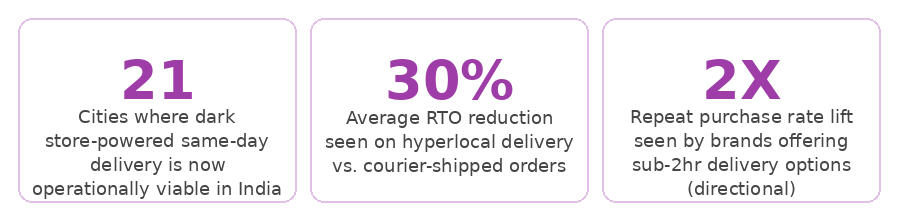
* All figures are directional estimates from Zippee's operator network and publicly cited industry benchmarks. Not independently audited.
Why Dark Stores Are the Critical Node in a Unified Network
Speed as a Retention Lever, Not Just a Logistics Function
None of this is possible without physical infrastructure close to the consumer. A dark store positioned 3-5 km from a demand cluster is what converts a unified inventory pool from a software concept into a 30-minute delivery reality.
The dark store's role in unified commerce logistics isn't just speed. It's the fulfillment node that handles the highest-intent, lowest-patience customers: the shopper who wants a protein supplement before the gym, the parent who needs a baby product tonight, the person who ordered skincare at 11pm and expects it before lunch tomorrow.
Brands that have integrated dark store fulfillment into their channel mix have seen a meaningful shift in consumer behavior. Delivery speed becomes a retention lever, not just a logistics function. We've written about this dynamic in detail.
The Mistake Brands Make With Dark Store Inventory
The mistake brands make is treating the dark store as a separate channel with its own SKU set and inventory. That's just creating another silo. The play is to treat the dark store as the fastest node in a unified network, fed from the same inventory pool, managed under the same replenishment logic.
Common Operational Blockers - and How Leading Brands Overcome Them
The Integration Problem
The operational blocker is almost never strategy. It's integration. Most brands carry a patchwork of systems: a Shopify or custom storefront, a 3PL WMS that wasn't built for multi-node operations, and marketplace feeds that update on a lag. Stitching these into a real-time unified view requires engineering effort most brand teams don't have the bandwidth for.
The Forecasting Problem
The second blocker is forecasting. Unified pooling only works if you know what to stock where. If your dark store in Andheri is chronically understocked on your top-10 SKUs because your demand signal is two days stale, you haven't solved anything. You've just moved the problem.
The brands making this work are the ones who've chosen infrastructure partners that own the hard parts: the node network, the real-time inventory API, the demand signal, and the last-mile SLA. We've covered the unit economics of this model in our analysis of building a dark store business case for D2C brands.
How Fulfillment Infrastructure Enables Unified Commerce at Scale
Zippee is not a courier. It's not a 3PL in the traditional sense. The right mental model is fulfillment infrastructure: a network of dark stores across 21 Indian cities, purpose-built for quick commerce logistics, integrated with brand stacks, and designed to be the hyperlocal delivery layer for D2C brands that don't want to build this themselves.
For brands like Epigamia, HealthKart, Supertails, and Clinikally, Zippee operates as the node network that lets their online orders arrive in 30 to 60 minutes, without requiring them to own dark store real estate or manage last-mile operations. The inventory integration is two-way: Zippee's system talks to the brand's OMS so stock is visible, updated, and replenishment-triggered in real time.
The result is unified commerce logistics that actually runs, not on a whiteboard, but at the SKU level, in the cities where your consumers are already ordering from quick commerce platforms and expecting that standard from you too.
If you're carrying excess safety stock, dealing with stockouts on one channel while another sits idle, or watching RTO rates erode your contribution margin, those are infrastructure problems. And infrastructure problems need infrastructure solutions, not another vendor to blame.
Bottom line: Unified commerce logistics isn't a 2027 roadmap item for Indian D2C brands. It's the operating model that separates brands compounding on consumer loyalty from those stuck managing channel complexity. The infrastructure to do it, including dark store networks, real-time inventory APIs, and same-day delivery rails, exists today. The question is whether your fulfillment is set up to use it.
Turn your fulfilment into a competitive advantage. Join our waitlist.


.png&w=256&q=75)
.png&w=256&q=75)


.png&w=256&q=75)


