Quick Commerce Pricing - D2C Margin Protection Guide
Charging a delivery premium for speed is not the answer. Brands that have tried it have trained their customers to wait. The smarter play is to engineer your unit economics so that speed is free for the customer and profitable for you. Here is how.
Why Quick Commerce Is a Cost Structure Problem, Not a Pricing Problem
Most D2C brands frame the quick commerce question wrong. They ask: “What can we charge customers for 30-minute delivery?” That is the wrong starting point. Customers on your own website or app have already made the highest-trust, highest-intent purchase decision available to you. Layering a Rs 49 or Rs 99 express fee on top of that breaks the deal for a meaningful share of them.
The real question is: what does it cost us to fulfill fast, and how do we structure the business so that cost is either recovered elsewhere or genuinely lower than we assume? That reframe unlocks a completely different set of levers. The brands winning on D2C fulfillment today are not winning because they have a better surcharge strategy. They are winning because they have a better cost structure.
The Four Fulfillment Cost Levers That Determine Your Speed Economics
Quick commerce logistics in India has a reputation for being expensive. Some of that reputation is earned. But the cost-per-shipment number that shows up on your P&L is a composite of four very different things, and most brands have only looked hard at one or two of them.
1. Last-Mile Cost Per Order
In a dark store model, last-mile is short. A rider covering a 3-5 km radius from a well-located dark store in Delhi NCR or Bengaluru typically delivers 15-22 orders per day at a cost to the operator of Rs 60-90 per drop (directional estimate, varies by city density and order batch). Compare that to a traditional hub-and-spoke courier reaching the same pin code from a 25 km distance: the per-drop economics look similar on paper, but the time-to-door is 6x longer and the return-to-origin rate is structurally higher.
2. Return-to-Origin (RTO) Rate
This is the margin killer most quick commerce conversations underweight. An RTO on a prepaid order costs you the outbound shipping, the return shipping, and the labor to reprocess. Brands on traditional 3PL networks in India see RTO rates of 15-30% depending on category. Same-day delivery brands consistently report RTO below 5%, because the customer is home, the delivery window is short, and purchase intent is higher. At scale, the RTO savings alone can fund the speed premium.
3. Inventory Carrying Cost
A dark store with 200-400 SKUs is not a warehouse. It is a curated assortment of your top movers, positioned close to demand. That means lower days of inventory, faster turns, and less capital tied up in safety stock. For nutraceuticals (HealthKart) or pet food (Supertails), proximity-to-consumer directly protects margin.
4. Customer Acquisition vs. Retention Math
The brands that justify quick commerce investment most cleanly are thinking about LTV, not individual order economics. If same-day delivery on your D2C channel drives a measurable lift in repeat rate, the per-order cost of speed gets distributed across a longer revenue stream. Even a 10-15% improvement in 90-day repeat rate changes the math substantially.
Delivery Pricing Frameworks by Segment: What to Charge (and When to Charge Nothing)
There is no single right answer. But here is a framework that holds up across categories:
| Scenario | Pricing approach | When it works | Watch out for | Verdict |
| Free same-day, no AOV gate | Speed fully subsidized | High LTV categories; retention play vs. aggregators | Basket erosion if customers cherry-pick single units | Use selectively |
| Free same-day above AOV threshold | Speed as basket-builder | Consumables, personal care, health supplements | Threshold calibration is critical | Strong default |
| Express fee Rs 29-79 for sub- 2 hr | Speed as premium feature | Gifting, urgency categories, B2B samples | Trains price sensitive segments to wait | Category-specific |
| Speed parity, recover via ops | Cost engineering play | High order density per dark store | Requires volume discipline upfront | Aspirational target |
| Subscription / prepaid delivery pass | Speed as retention mechanic | Nutraceuticals | CRM and billing complexity | High potential |
| Flat-rate premium, no minimum | Transparent speed pricing | Low-AOV impulse categories | Margin dilution on small baskets | Handle with care |
Framework based on observed D2C patterns across Zippee’s brand network. Not a substitute for your own cohort analysis.
Why Your D2C Channel Changes the Quick Commerce Math vs. Aggregators
Quick commerce in India is increasingly understood through the lens of Blinkit, Zepto, and Swiggy Instamart. Those platforms have trained tens of millions of consumers to expect 10-minute delivery. But they have done it at a structural cost to brands worth naming clearly.
On aggregator platforms, you do not own the customer relationship. You pay for placement. Your pricing is visible to competitors in real time. And your brand experience ends the moment a rider picks up the bag. For high-AOV, high-consideration categories like premium skincare (Clinikally) or fashion (Myntra), this is a real constraint.
The D2C quick commerce thesis is different. When a customer orders directly from your app or website and receives the order in under 60 minutes, you have delivered a premium brand experience at speed and own the post-purchase relationship. That asymmetry has real economic value, in NPS, in review velocity, in repeat rate, that belongs on your pricing spreadsheet even if it doesn’t show up there today.
Brands on Zippee’s network operating their own D2C quick commerce channel report that customers who experience a sub-60-minute delivery show measurably higher 30-day repeat rates compared to customers fulfilled via standard courier. The attribution is directional, but the pattern is consistent enough to take seriously.
Dark Store Economics: The Order Density Thresholds That Make Speed Profitable
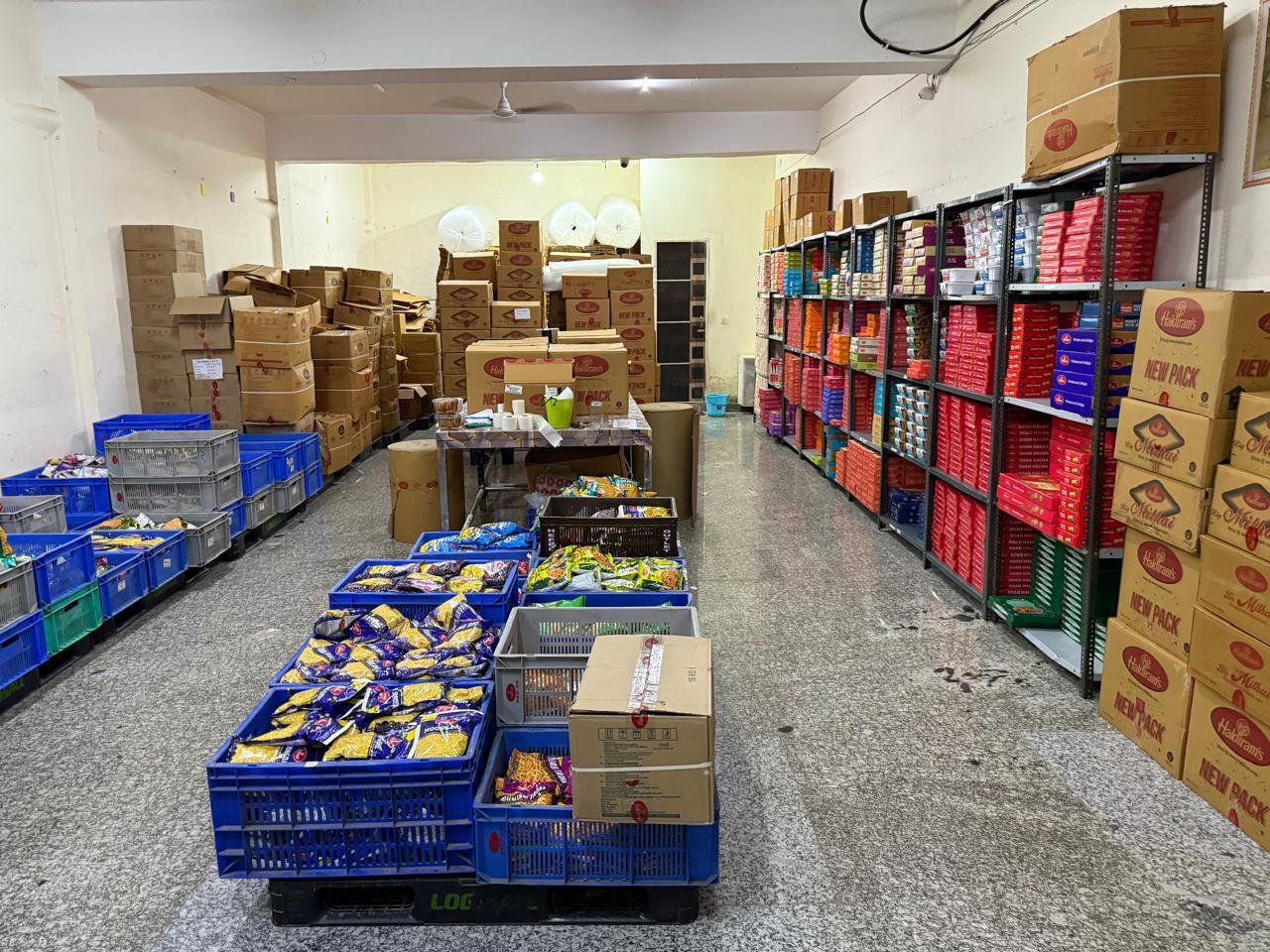
A dark store is not a small warehouse. It is a precision instrument. The economics only work if you get three things right: location, assortment depth, and order density.
A reasonably well-run dark store in a Tier 1 Indian city needs to process a minimum of 80-120 orders per day to cover fixed costs at a per-order level competitive with traditional fulfillment. Below that threshold, you are paying a quick commerce premium for slow commerce economics. Above 150-200 orders per day, the per-drop cost starts to fall meaningfully, and speed-for-free becomes structurally achievable.
This is why hyperlocal delivery in India has largely been a game for brands with existing order density or platforms aggregating multiple brands across a single dark store footprint. A standalone D2C brand doing 30 orders a day in Koramangala cannot justify a dedicated dark store. But the same brand running its fulfillment through a shared dark store network, alongside 20 other brands, can get the economics to work at a fraction of the fixed cost.
Read Zippee's blog for a deeper look at how the dark store model is evolving for D2C brands in India.
How Shared Dark Store Infrastructure Makes Quick Commerce Viable for D2C Brands
The quick commerce logistics India conversation too often reduces to which courier is fastest. That framing undersells what the problem actually requires. Speed at scale requires a different operational architecture, dark stores positioned against demand clusters, rider networks calibrated to order velocity, and integrations that let a brand’s OMS, WMS, and CRM talk to each other without custom engineering.
Zippee is built to be that infrastructure layer for D2C brands and marketplaces. We operate a network of dark stores across 21 cities including Delhi NCR, Mumbai, Bengaluru, and Hyderabad, and power 30-minute, 60-minute, and same-day delivery for brands like HealthKart, Epigamia, Supertails, Clinikally, and Myntra, not as a delivery vendor but as a fulfillment operating system.
Brands on the Zippee network do not solve dark store real estate, rider operations, or last-mile tech individually. They plug in and inherit an operating layer stress-tested across category types and city geographies. The pricing strategy work described above becomes considerably more tractable when the underlying cost structure is not something you’re building from scratch.
Building a Fulfillment Architecture That Turns Speed Into a Structural Advantage
Speed is not a feature you bolt on. It is an outcome of a cost structure and an operational architecture designed for it. The brands that will win on quick commerce over the next three years are not the ones with the cleverest surcharge model. They are the ones that internalized, early, that hyperlocal delivery and low RTO are the same investment, and built accordingly.
If you are still treating same-day delivery as a premium add-on rather than a structural capability, you are solving the wrong problem. The infrastructure to do it profitably exists. The question is whether you build it, buy it, or partner into it.
Ready to turn your fulfillment into a competitive advantage?
If you’re ready to turn your fulfillment into a competitive advantage, join our waitlist.


.png&w=256&q=75)
.png&w=256&q=75)


.png&w=256&q=75)


