D2C Compliance: Fix Pharma & Nutraceutical Logistics Now
Compliance in pharmaceutical and nutraceutical D2C is not a legal checkbox. It is operational infrastructure. The brands that treat it as the former will learn this the hard way.
Here is the uncomfortable reality: most D2C brands in the pharma and nutraceutical space are growing fast, investing in performance marketing, and quietly ignoring the compliance scaffolding that their logistics and fulfillment stack requires. Not because they are careless. Because the logistics vendors they use were never designed to handle Schedule H drugs, temperature-sensitive probiotics, or FSSAI-regulated health supplements with any rigor beyond “ship it.”
The market makes this tension more acute. India’s nutraceuticals industry is projected to cross $18 billion by 2027 (ASSOCHAM estimate, directional), and the OTC and self-care pharma segment is growing alongside it as consumers self-prescribe everything from collagen to Vitamin D3 to adaptogens. Quick commerce has accelerated this. People now expect their protein powder and their antacids in 30 minutes. The pressure on brands to deliver fast has never been higher. But the pressure to deliver right, in compliance with CDSCO, FSSAI, and state licensing frameworks, has not gone away.
The brands that figure out how to do both simultaneously will compound their advantage. The ones that treat compliance as a separate, slow lane will either hit regulatory walls or build fragile operations that crack at scale.
Why Compliance Risk Lives in the Fulfillment Chain, Not the Legal Department
Where Generic 3PLs Fall Short for Health and Pharma Brands
Most founders delegate compliance to a regulatory affairs consultant who produces documentation, and then assume the problem is handled. It is not. The compliance risk in pharmaceutical and nutraceutical D2C lives inside the fulfillment chain: storage conditions, picker training, license validity at the point of dispatch, batch tracking, and customer-facing documentation.
FSSAI’s regulations under Schedule 2A govern nutraceuticals including protein supplements, vitamins, minerals, and herbal extracts. Any brand selling these products direct-to-consumer must ensure they are stored, labeled, and dispatched in a manner consistent with the product’s license. For products regulated under the Drugs and Cosmetics Act (Schedule H, H1, X), the bar is higher: a licensed pharmacist must supervise dispensing, and cold chain requirements may apply depending on the molecule.
The Hidden Violations Happening at the Picker and Dispatch Level
Where this breaks down in practice: brands go live on their website or a marketplace, plug in a generic 3PL or courier partner, and run fulfillment from a godown that has no understanding of these distinctions. The picker does not know that Omega-3 capsules need to be kept below 25°C. The courier does not know that dispatching a Schedule H product without a pharmacist-verified order is a licensing violation. And the brand does not know any of this is happening until an inspection or a customer complaint surfaces the problem.
"The compliance risk in pharmaceutical D2C lives inside the fulfilment chain, not the legal department"
The Temperature Control Gap Most D2C Brands Don't Know They Have
Which SKU Categories Are Most Exposed
A significant share of nutraceutical and pharmaceutical SKUs are temperature-sensitive, and the problem is not limited to biologics or vaccines. Probiotics, fish oil capsules, certain herbal extracts, and multiple OTC products have defined storage conditions. Most D2C brands ship these through standard fulfillment infrastructure with ambient storage and unmonitored last-mile delivery.
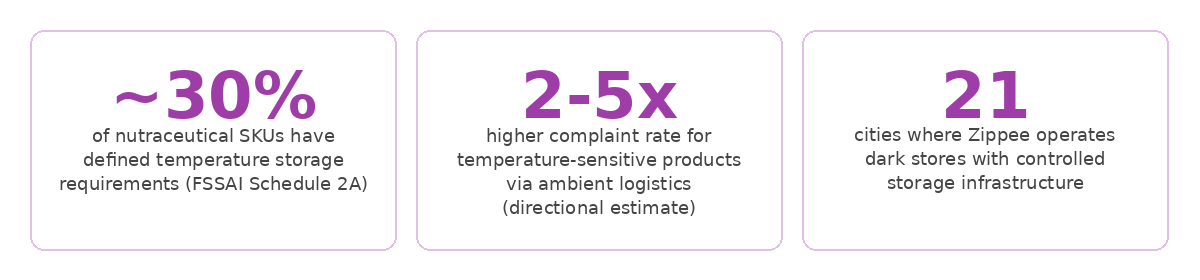
* Temperature sensitivity % is a directional estimate based on FSSAI Schedule 2A product categories. Industry complaint rate comparison is based on operator-reported data.
How Improper Storage Silently Kills Retention and Invites Inspection
The consequence is product degradation that does not show up immediately. A customer receives their probiotic supplement, uses it for 30 days, and sees no results. They churn and leave a 2-star review. The brand attributes it to product-market fit or category skepticism. The real cause is that the product was stored in a 38°C godown in Delhi in May.
For brands operating at scale, this is both a regulatory risk and a retention problem. FSSAI inspections increasingly include cold chain audits for relevant product categories. A brand that cannot demonstrate proper storage and transit conditions for its temperature-sensitive SKUs is exposed.
India's Pharma and Nutraceutical Licensing Matrix: What You Need and Where
License Requirements by Product Category and Channel
India does not have a single national license for D2C pharmaceutical or nutraceutical commerce. Licensing is a matrix of product type, state, and channel. The table below is a directional framework, not legal advice. Consult your regulatory counsel for specifics.
| Product Category | Governing Body | Key License | Dark Store Requirement | Fast Delivery? |
| Nutraceuticals (vitamins, proteins, herbs) | FSSAI | FSSAI Central / State License | FSSAI-registered storage | YES |
| OTC drugs (antacids, analgesics, antiseptics) | CDSCO / State Drug Authority | Drug License (Form 20/21) | Licensed premises + pharmacist | YES |
| Schedule H / H1 drugs | CDSCO | Drug License + Rx requirement | Licensed pharmacist on-site mandatory | LIMITED |
| Schedule X (controlled substances) | CDSCO | Separate X-category license | Enhanced security, audit trail | NOT SUITED |
| Ayurvedic / herbal (AYUSH) | AYUSH Ministry | AYUSH manufacturing license | FSSAI registration if food form | YES |
| Homeopathic products | State Drug Authority | Homeopathic drug license | Standard licensed storage | COMPATIBLE |
Why the Licensing Burden Should Shift from Brand to Infrastructure
The critical insight in this table: most of the high-growth nutraceutical and OTC segments are compatible with fast delivery, including 30-minute and same-day delivery, if the dark store or fulfillment node from which you are dispatching carries the correct licenses. The licensing burden shifts from a brand problem to an infrastructure problem. And that is where most brands fail to think correctly. They try to hold the license themselves and operationalize it inside a general-purpose 3PL, rather than working with fulfillment infrastructure that already has the compliance layer built in.
How High RTO Rates Become a Regulatory and Revenue Problem in Health Categories
Why Returned Health Products Are Not Resalable
Return-to-origin rates in Indian e-commerce average 20–35% across categories (Shiprocket State of E-commerce 2024, directional). In health and wellness D2C, the problem has a specific wrinkle: returns of consumable health products raise regulatory questions. Can you resell a returned supplement? A returned OTC drug? In most cases, no, without re-inspection. This means RTO in pharma and nutraceutical D2C is not just a logistics cost: it is destroyed inventory.
The Case for Hyperlocal Fulfillment as an RTO Reduction Strategy
This makes delivery speed a compliance lever, not just a revenue lever. Faster delivery, especially hyperlocal delivery from a dark store within 5–10 km of the customer, consistently produces lower RTO rates. Our own data across brands using Zippee’s fulfillment network (see: RTO Reduction Playbook) shows 30-minute and 60-minute delivery consistently delivers RTO rates 40–60% lower than next-day or 2-day fulfillment for the same SKUs.
For a brand shipping Rs. 1,200 average order value supplements, every RTO prevented is ~Rs. 1,200 in revenue saved plus ~Rs. 80–150 in avoided reverse logistics cost plus the regulatory complication of handling returned health products. The math on investing in fast, local fulfillment infrastructure becomes obvious quickly.
What Compliant Quick Commerce Infrastructure Actually Requires
Brands ask us what it takes to run compliant quick commerce in the pharma and nutraceutical category. The answer is not a single product or feature. It is a stack of infrastructure decisions that most generic 3PLs have not made.
First, the dark stores or micro-fulfillment nodes from which you dispatch must carry FSSAI registration at minimum, and drug licenses if you are handling OTC or Rx products. These are not transferable from the brand to the 3PL. They are specific to the premises and the operator.
Second, storage must be zoned and temperature-monitored for product categories that require it.
Third, picker and dispatch staff need category-specific training. A picker who handles apparel one shift and probiotics the next is not a sufficient control.
Fourth, for any product requiring pharmacist oversight, that oversight must be documentable, not assumed.
Fifth, and most overlooked: your digital stack must be able to handle batch tracking, expiry management, and first-expiry-first-out (FEFO) logic.
This is table stakes for any pharmaceutical fulfillment operation. Most generic D2C fulfillment platforms do not offer FEFO natively. See: Dark Store Operations for D2C Brands.
How Purpose-Built Fulfillment Infrastructure Solves Compliance and Speed Together
Zippee operates a network of dark stores across 21 cities including Delhi NCR, Mumbai, Bengaluru, and Hyderabad, purpose-built for D2C brands that need fast, reliable, and categorically compliant fulfillment. We currently power same-day and sub-60-minute delivery for brands across health, wellness, and nutraceuticals, working with partners including HealthKart and Epigamia.
For pharma and nutraceutical brands specifically, what this means operationally: our dark stores are FSSAI-registered, our storage infrastructure is zoned and monitored, our fulfillment tech handles FEFO and expiry management, and we are building out licensed pharmacist integration for brands requiring Schedule H-compatible fulfillment nodes. We are not a courier company with a warehouse. We are the operational infrastructure layer that sits between a brand’s manufacturing and its customer’s doorstep.
The analogy that resonates with most founders we work with: Zippee is to D2C fulfillment what a cloud provider is to software. You do not build your own servers because compliance, reliability, and scale are better handled by infrastructure that is purpose-built for it. The same logic applies to quick commerce logistics India. Building your own compliant dark store network across 10 cities is a distraction from your core product. Plugging into one that already exists is a competitive advantage.
The brands that will win in pharmaceutical and nutraceutical D2C over the next three years are the ones that figure out they are in the compliance-plus-speed business, not one or the other. Regulatory frameworks are tightening, not loosening. Consumer expectations for delivery speed are not reverting. The brands that treat these as competing constraints will be slow. The ones that treat them as jointly solvable infrastructure problems will compound.
Turn your fulfilment into a competitive advantage. Join our waitlist.


.png&w=256&q=75)
.png&w=256&q=75)


.png&w=256&q=75)


